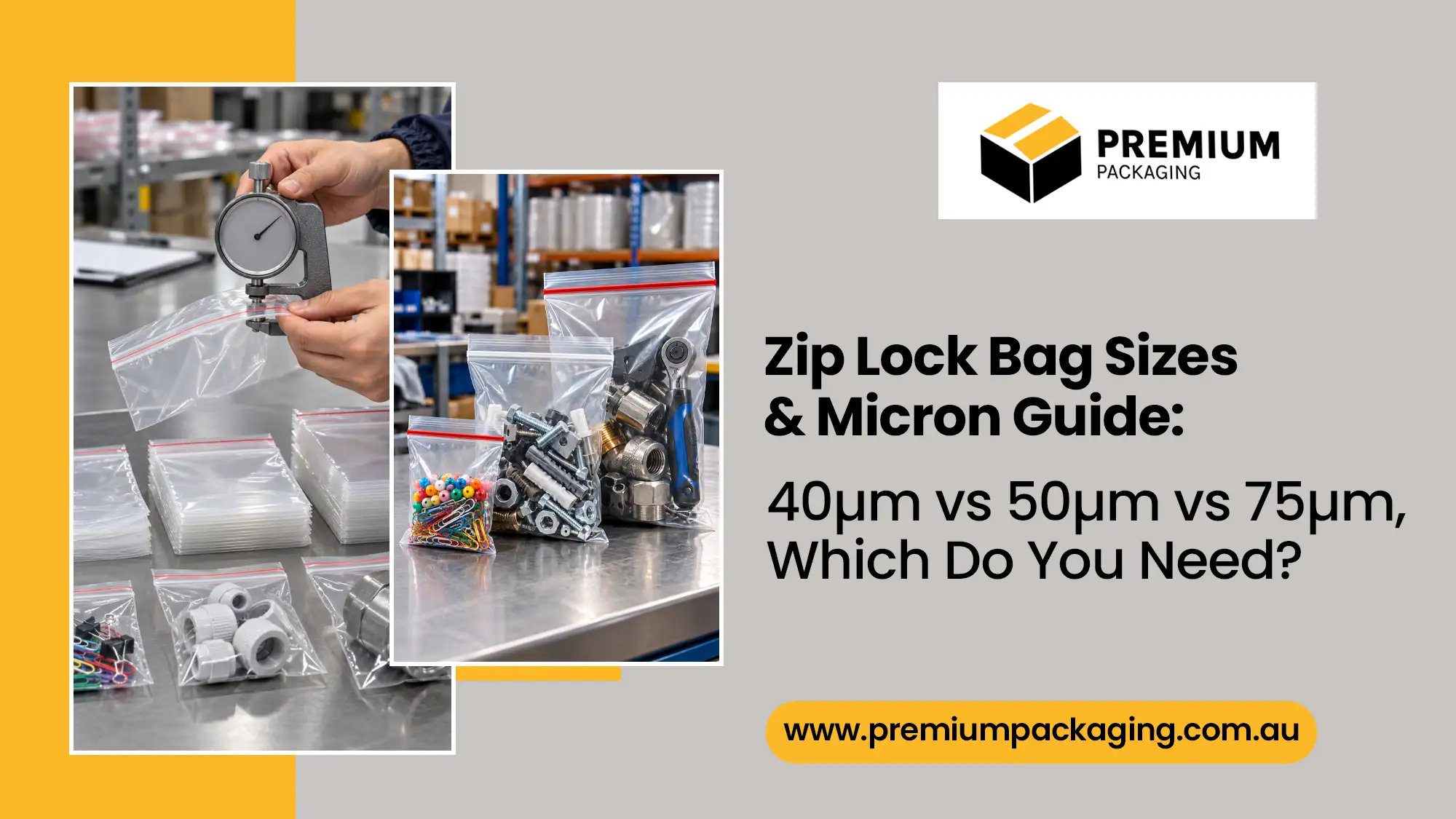
Zip Lock Bag Sizes and Micron Guide: 40µm vs 50µm vs 75µm, Which Do You Need?
Zip lock bags look interchangeable in a catalogue. Two bags of the same dimensions can behave completely differently in use, because the gauge of the film decides whether the bag holds its contents or splits at the seal. Order too light and you get burst bags, spilled stock and repacking. Order heavier than the job needs and you are paying for film your contents never required.
This guide sets out what each gauge is built for, how zip lock bag sizes are measured, and how to land on the right specification before you place a bulk order. It is written for procurement teams, warehouse and dispatch managers, and anyone buying resealable bags for a commercial operation.
What Micron Actually Measures
Micron, written as µm, is the thickness of the film the bag is made from. One micron is one thousandth of a millimetre, so a 75µm bag is roughly half as thick again as a 50µm bag. Higher gauge film resists puncture and tearing better, holds more weight without stretching at the seal, and stands up to repeated opening and closing.
Zip lock bags are also sold as press seal, preseal, resealable, clipseal and snap lock bags. The names differ by supplier; the specification does not: what you are buying is a low-density polyethylene bag with an interlocking press closure, described by its two dimensions and its gauge.
40µm: Light Duty
Forty microns is the entry gauge. The film is noticeably thin and flexible, which suits small, light, smooth contents that are packed once and not handled much afterwards. It is commonly used for displaying or storing large quantities of very small items where the bag is a holder rather than a protective layer.
The limitation is that it punctures and tears readily. Anything with a corner, a thread or a sharp edge will find a weakness, and the seal can pull open under weight. It is also not the gauge for bags that will be opened and closed many times, because the closure wears faster on thin film.
Best for: small, light, smooth-edged items such as beads, buttons and small components; short-term storage; sorting and kitting where the bag is simply holding a count together.
50µm: The Commercial Standard
Fifty micron is the working gauge for most commercial applications, and it is where the majority of business orders land. It is thick enough to hold weight without stretching at the seal, resist everyday handling and survive repeated opening and closing, while staying flexible and easy to pack. Press seal bags in 50µm cover the broadest range of day-to-day uses, from small parts through to larger retail and storage applications.
If you are not sure which gauge to order and your contents are not especially heavy or sharp, 50µm is the sensible default. It is the gauge most operations standardise on so that one specification covers the bulk of their packing.
Best for: general warehouse and dispatch packing, small parts and hardware, pharmacy and dispensing, food pre-portioning, sample packs, retail packing and repackaging, and anything opened and resealed regularly.
75µm: Heavy Duty
Seventy-five microns is the heavy-duty gauge, built for contents that would defeat a lighter bag. The extra thickness gives real puncture and tear resistance, holds heavier contents without the seal pulling apart, and withstands repeated handling and longer freight legs. Heavy duty press seal bags in 75µm are stocked in twelve sizes, running from 50mm x 50mm up to 380mm x 510mm, so the gauge is available across both small parts and bulkier contents.
Choose it whenever the contents have weight, sharp edges or abrasive surfaces, or when the bag will be handled repeatedly before it reaches its destination. Fixings, fasteners, metal components, tooling and machined parts are the usual candidates.
Best for: fixings, fasteners and hardware; metal components and machined parts; sharp or abrasive contents; heavier fills; long freight legs and bags handled many times.
40µm vs 50µm vs 75µm at a Glance
Gauge
Film character
Handles
Typical applications
40µm
Thin and flexible, punctures easily
Light, smooth, packed once
Beads, buttons, small components, short term storage
50µm
Balanced, holds weight, reseals well
Everyday commercial contents
Small parts, pharmacy, food portioning, retail packing
75µm
Thick, puncture and tear resistant
Heavy, sharp or abrasive contents
Fixings, hardware, metal components, tooling
How Zip Lock Bag Sizes Are Measured
Sizes are given as two dimensions in millimetres: the width of the opening first, then the length. The length is measured from the seal down to the bottom of the bag, so the zip strip itself sits above that measurement. This matters when you are ordering, because a bag quoted at 150mm x 230mm gives you 230mm of usable depth below the closure rather than 230mm overall.
Two practical rules keep the order right. Allow a little more width than the widest point of your item, since contents need to sit flat rather than stretch the film at the seal. And allow enough depth that the contents sit below the zip, because a bag filled to the closure will not seal reliably and will work open in transit.
Choosing the Right Size and Gauge
Work through four questions before you order:
What is going in it? Smooth and light points to a lighter gauge. Sharp, heavy or abrasive points to 75µm.
How often will it be opened? Repeated access wears a thin closure, so step up the gauge for bags that are resealed often.
How far does it travel and how is it handled? Longer freight legs and more touchpoints justify a heavier gauge.
Does the contents need to be visible or written on? Clear film suits picking and identification, which matters for parts and dispensing.
A practical test on your current bags: if any are splitting at the seal, bursting in transit or working open before they arrive, the gauge is too light for the job rather than the bags being faulty.
Matching the Gauge to Your Industry
Industry
Common use
Usual gauge
Hardware and industrial distribution
Fixings, fasteners, components, kitting
75µm
Warehousing and dispatch
Small parts, spares, picking and sorting
50µm
Pharmacy and healthcare
Dispensing, sample and specimen packing
50µm
Food service and food retail
Pre-portioning and ingredient storage
50µm, food grade
Retail and eCommerce
Accessories, repackaging, multipacks
50µm
Jewellery and small goods
Beads, findings, very small items
40µm to 50µm
Food Grade and Compliance
If bags will hold food, confirm the film is a food-grade specification before ordering, and keep that documentation on file for your own food safety system. Resealable bags are widely used for pre-portioning and ingredient storage in food service, but food contact suitability is a specification question that should be confirmed for the exact product you are buying rather than assumed from the material.
Buying in Bulk Without Overspecifying
The most common ordering mistake is running one gauge across everything. Operations that pack both light retail items and heavy fixings usually do better holding two gauges, a 50µm for general packing and a 75µm for the demanding lines, than forcing one specification to cover both. Browse the zip lock and preseal bag range to compare the stocked gauges and sizes. Where contents are heat sealed rather than resealed, or where a bag is opened only once, plain poly bags are the better and simpler specification.
Zip lock bags sit within the wider plastic packaging range, so most operations reorder them alongside their other bag lines on the same cycle.
Sustainability Considerations
Specifying correctly is the most direct way to reduce plastic use. A bag matched to its contents uses the least film that will still do the job, while an over-specified gauge puts more plastic into every pack for no gain. Low density polyethylene bags can also enter commercial soft plastic recycling streams rather than going to landfill, so reviewing both gauge and size across your most-used lines is a practical step toward lower material use.
Order Zip Lock Bags Through Premium Packaging
Premium Packaging supplies resealable zip lock and press seal bags to Australian businesses in wholesale carton quantities, in the gauges and size ranges commercial operations actually use. Our team can confirm the right specification for your contents rather than leaving you to guess from a size chart, and custom sizes and gauges can be arranged where the stocked range does not fit. Start with 50µm press seal bags for general packing or 75µm heavy duty for demanding contents.
Orders ship from our Werrington warehouse in Western Sydney to businesses nationwide, and we can set up recurring supply for lines you reorder on a cycle. Further buying guidance is published on the Premium Packaging blog.
Frequently Asked Questions
What micron zip lock bag do I need? It depends on the contents. Light, smooth items suit 40µm, everyday commercial packing suits 50µm, and heavy, sharp or abrasive contents call for 75µm. If you are unsure and the contents are not demanding, 50µm is the sensible default.
Is a higher micron always better? No. A heavier gauge adds material and uses more plastic without any benefit on light, smooth contents. The aim is to match the gauge to the weight, edges and handling the bag will actually face.
How are zip lock bag sizes measured? Sizes are listed as width of the opening by length in millimetres, with the length measured from the seal down to the bottom of the bag. The zip strip sits above that measurement, so allow depth for contents to sit below the closure.
What is the difference between zip lock bags and press seal bags? They are the same product under different trade names, along with preseal, resealable, clipseal and snap lock. All describe a polyethylene bag with an interlocking press closure, specified by its two dimensions and its gauge.
Why do my zip lock bags keep splitting at the seal? Usually the gauge is too light for the contents, or the bags are overfilled so the film stretches at the closure. Step up to a heavier gauge, or move to a larger size so contents sit below the zip.