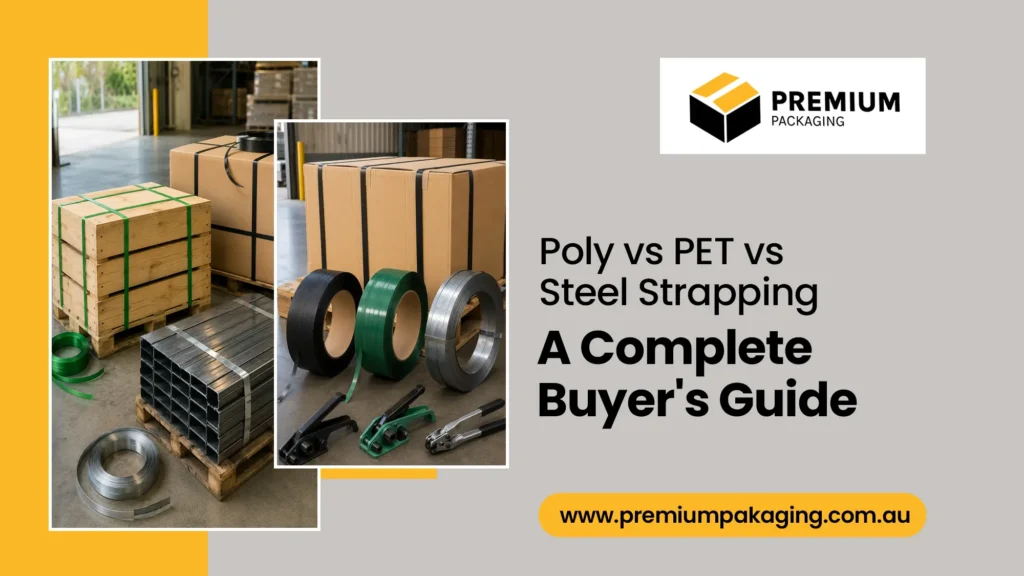
Poly vs PET vs Steel Strapping: A Complete Buyer’s Guide
Strapping is one of the most specified yet least examined items in a warehouse. Many operations reach for whatever roll is on the bench, but the strap that holds a pallet of cartons is rarely the right one for a bundle of steel, and a strap that loosens in transit can turn a compliant load into a failed one. Choosing between poly, PET and steel strapping is a load restraint decision, and getting it right protects your goods, your people and your delivery record.
This guide sets out what each of the three main strapping materials does well, where each falls short, and how to match the strap to your loads. It is written for procurement teams, warehouse supervisors and dispatch managers who need loads to arrive secure without over-specifying or under-specifying the material.
What strapping does and why the material matters
Strapping bundles, reinforces and secures products for handling, storage and transport. A strap applied around cartons, packs or a palletised load holds the unit together so it resists the shifting, settling and vibration that freight puts it through.
Two properties separate the materials: break strength, which is how much force the strap withstands before it fails, and elongation with recovery, which is how much the strap stretches under tension and how well it pulls back to stay tight. A load that settles or absorbs impact needs a strap that recovers. A rigid load that never moves needs a strap that does not stretch at all. This is why one material cannot cover every job.
Poly (Polypropylene) strapping
Poly strapping is the everyday workhorse of Australian warehouses. Made from polypropylene, it is light, flexible and easy to apply by hand or machine, which makes it the practical choice for high-volume, lower tension work.
Poly has higher elongation than the other two materials, meaning it stretches under load. That flexibility suits bundling and light to medium pallet loads where the strap needs to give a little, but it also means poly loses tension over time and is not the strap for heavy or long-stored loads. It is safe to handle with no sharp edges, recyclable, and available in hand and machine grades.
Best for: carton bundling, reinforcing parcels, unitising light to medium pallet loads, and fast-moving packing lines. Ecommerce fulfilment, retail distribution, food and beverage dispatch and general manufacturing all rely on poly strapping for everyday securing.
PET (Polyester) strapping
PET strapping, also called polyester strapping, is the strongest plastic strap and the usual answer when poly is not enough but steel is more than the load needs. It combines high tensile strength with low elongation and excellent recovery, so it applies at high tension and then holds that tension as the load settles.
That recovery is the key difference. Where poly slackens and steel simply holds rigid, PET flexes under a sudden impact and pulls back tight, which keeps settling loads secure through long transport and storage. It resists UV and moisture, handles outdoor conditions, is safe to handle without the recoil and edge hazards of steel, and is recyclable. For many operations, it is a direct alternative to steel on heavy but non-rigid loads.
Best for: palletised heavy goods, bricks, tiles, timber packs, drums, and any load that will be handled repeatedly or stored for extended periods. Manufacturers, exporters, timber and building suppliers and long haul freight operations specify PET where retained tension matters.
Steel strapping
Steel strapping sits at the top for raw strength and rigidity. Made from cold-rolled steel, it has the highest break strength of the three, effectively zero stretch, and it holds heavy, rigid loads that must not move at all.
Its strengths are also its trade-offs. Steel has sharp edges and can recoil under tension, which makes operator safety and correct tooling essential. It can rust in damp or outdoor conditions; it is heavier to handle and transport, and it is best suited to loads that do not settle, because it has almost no give to accommodate movement. Where a load is rigid, dense and unforgiving, steel is the specification. Where a load flexes or settles, a plastic strap usually holds better.
Best for: steel coils, pipes, I beams, heavy machinery and metal components, and export grade timber packs that demand maximum strength and zero elongation through rough handling and long transport.
Poly vs PET vs Steel: side by side
Property
Poly (PP)
PET (polyester)
Steel
Relative break strength
Light to medium
High
Highest
Elongation and recovery
High stretch, low retained tension
Low stretch, excellent recovery
No stretch, rigid hold
Best load type
Light cartons and pallets
Heavy loads that settle or shift
Heavy rigid loads that do not move
Handling safety
Safe, no sharp edges
Safe, no sharp edges
Sharp edges, recoil risk
Weather and UV
Short to medium exposure
UV and moisture resistant
Can rust in damp conditions
Recyclable
Yes
Yes
Recyclable, harder to process
Typical tooling
Tensioner and sealer, buckles, or battery tool
Tensioner and sealer with PET seals, or sealless battery tool
Steel tensioner, heavy sealer and steel seals
How to choose the right strapping for your loads
Work backwards from the load. If you are bundling cartons or securing light to medium pallets at volume, poly is the sensible everyday choice. If your loads are heavy, dense or likely to settle in transit, and you want the security of steel without the weight and safety concerns, PET is usually the answer. If your loads are rigid, very heavy and must not stretch at all, such as metal or export timber, steel earns its place.
A simple test after handling and transport tells you whether you chose correctly: is the load still secure without needing to be re-strapped? Loose loads on arrival point to a strap with too much stretch or too little strength for the job.
Do not overlook tools and seals
The strap is only half the system. Poly and PET are secured with a tensioner and either metal seals or a friction weld, and both run on manual hand tools, semi-automatic and fully automatic machines, or battery-powered seal-less tools for higher volumes. Steel requires heavier dedicated tensioners, sealers and steel seals. Matching the tool and seal to the strap width and material is what turns a roll into a secure joint, so it is worth specifying the strapping tools, seals and accessories at the same time as the strap.
A strong alternative: polywoven strapping
Where a load needs steel-level strength but a softer strap that will not scratch or damage surfaces, polywoven strapping is worth considering. Woven from polyester yarn, it offers high break strength with the safety and corrosion resistance of a plastic strap, and it is tensioned by hand with a simple buckle or tool. It is a common pick for furniture, machinery and other high value or awkward loads.
Load restraint and chain of responsibility
Under Australia’s Chain of Responsibility provisions in the Heavy Vehicle National Law, every party in the supply chain shares legal accountability for loads being safely restrained for road transport, and that includes the businesses that pack and strap them. Choosing a strap with adequate break strength and the right tension behaviour for the load, then applying it correctly with matched tools, is part of meeting that obligation. Under-specified strapping that fails in transit is both a safety risk and a compliance one.
Sustainability and handling safety
Both poly and PET are recyclable plastics and can enter commercial recycling streams rather than going to landfill. Specifying the correct strap also reduces waste, because a strap matched to the load holds it in fewer applications and with less breakage and rework than the wrong one. On safety, the plastic straps remove the sharp edges and recoil that make steel handling hazardous, which matters for busy packing stations and large teams. Where steel is genuinely required, correct tooling and operator training keep its handling risks controlled.
How Premium Packaging helps you specify correctly
Premium Packaging is a Sydney-based wholesale supplier stocking the full strapping range, poly, PET, steel and polywoven, along with the tensioners, sealers, seals and dispensers that go with them. Our specialists match strap material, width and break strength to your loads, handling equipment and freight lanes, so the recommendation fits your operation rather than a generic chart.
Stock is held at our Werrington warehouse with delivery across Sydney, Melbourne, Brisbane, Adelaide, Perth and regional Australia, and recurring supply arrangements keep your packing lines running as volumes grow. Strapping also works alongside pallet wrap and stretch film and custom cartons for a complete load securing setup. More packaging guidance is on the Premium Packaging blog.
Frequently asked questions
What is the difference between poly, PET and steel strapping?
Poly is a light, flexible plastic strap for cartons and light to medium loads. PET is a stronger plastic strap with excellent tension recovery for heavy loads that settle. Steel is the strongest and most rigid, suited to very heavy loads that must not move.
Is PET strapping a good alternative to steel?
For many heavy but non-rigid loads, yes. PET applies at high tension, recovers well after impact and holds settling loads securely, without the weight, sharp edges, recoil and rust that come with steel. Steel remains the choice for rigid, unyielding loads.
Which strapping is best for heavy pallet loads?
It depends on the load. Heavy loads that settle or absorb impact suit PET for its retained tension, while rigid, very heavy loads such as metal or timber packs suit steel. Poly is generally too flexible for heavy long-distance work.
Can I use the same tool for poly and PET strapping?
Often yes, as many tensioners and battery-powered tools handle both poly and PET across common widths, though seals differ by material. Steel strapping needs its own dedicated tensioners, sealers and steel seals.
Is plastic strapping recyclable?
Yes. Both poly and PET are recyclable and can enter commercial recycling streams. Choosing the correct strap for the load also cuts waste by reducing breakage, rework and the amount of strap used per load.