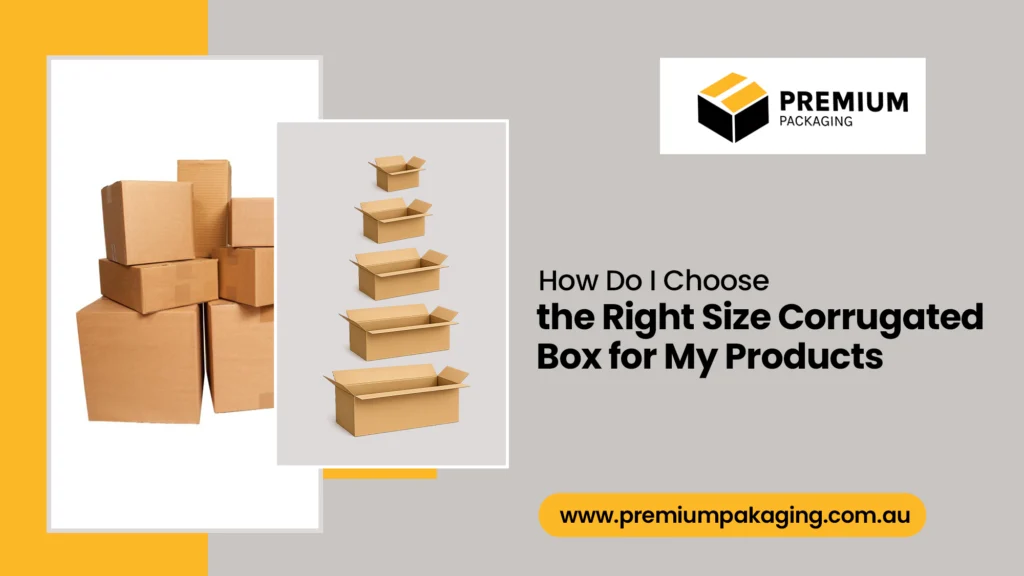
For any business that ships, stores or distributes goods, box size is one of the quietest cost centres in the operation. A carton that is slightly too large invites movement and damage, adds void fill you did not need, and lifts the freight you are billed on every consignment. A carton that is too tight splits at the seams and crushes its contents. Getting the size right, repeatably, across hundreds or thousands of orders is what separates a tidy dispatch process from one that bleeds money.
This guide covers how to choose corrugated box sizes for a commercial operation, from the measurements that matter through to the way box dimensions feed into freight billing and pallet planning.
Start with three measurements, not one
Most sizing mistakes trace back to measuring the box instead of the job the box has to do. Three numbers decide the right size:
- The product. Measure length, width and height at the widest points. For irregular or multi-piece items, measure the largest span in each direction so nothing is forced.
- The protection. Add clearance on every side for cushioning. For most goods, a 20 to 40 mm allowance per side suits bubble wrap, kraft padding or void fill. Fragile or high-value items need more.
- The board. Corrugated walls have thickness. Single wall adds a few millimetres; double wall adds more. This is why the internal and external dimensions of a carton are never the same number.
Add the first two together to find the internal size you need, then choose a stock carton whose internal dimensions match or slightly exceed it.
Internal dimensions are the figure that counts
Across the Australian corrugated trade, carton sizes are quoted as internal dimensions. The inside is the space your product actually occupies. If you order against external measurements, you risk a box that does not close or one that swallows your product in empty space.
External dimensions still matter, but for a different task. They are the figure you use when planning how cartons stack on a pallet and how many fit per layer. Keep both numbers in your specifications and label them clearly so your dispatch team and your supplier are reading the same thing.
Match wall strength to size, not just weight
Two cartons holding the same weight do not need the same board if they are different sizes. A larger box puts more unsupported span between its corners, so it flexes and crushes more easily under stacking pressure. As a box grows, board strength has to grow with it.
Single wall corrugated handles the bulk of retail and eCommerce dispatch: apparel, books, homewares and most packaged goods. Double wall earns its place when items are heavy, dense, awkward, or destined for long transit and high pallet stacks. If your cartons arrive with bowed sides or crushed corners, the board grade is usually the answer, not the tape.
Premium Packaging supplies durable corrugated stock cartons in a range of sizes, alongside corrugated cardboard rolls for wrapping and layering when a product needs extra support inside the carton.
How box size lands on your freight invoice
Here is the part most sizing guides skip. Australian carriers rarely bill on actual weight alone. They compare actual weight against cubic (dimensional) weight and charge on whichever is greater. Many domestic carriers apply a cubic conversion factor of 250 kg per cubic metre, calculated as:
Length (m) × Width (m) × Height (m) × 250 = cubic weight in kilograms
A 40 × 30 × 30 cm carton works out at about 0.036 cubic metres, or roughly 9 kg of cubic weight, even if the contents weigh two. Drop to a 30 × 25 × 20 cm carton that still fits the product and the cubic weight falls to around 3.75 kg. The product never changed. The box did. Multiply that gap across a month of consignments and right-sizing becomes one of the most direct levers you have on dispatch spend.
The smallest carton that still protects the product is almost always the cheapest to send.
Size your boxes to the pallet
If your goods move on pallets, box dimensions and pallet dimensions need to be considered together. The Australian standard pallet measures 1165 mm × 1165 mm. A carton footprint that divides neatly into that square wastes less space, builds more stable layers, and reduces the overhang that leads to crushed edges and rejected loads.
Before settling on a carton size, check how many units fit per pallet layer and how cleanly the layers stack. A box that is 20 mm too wide in each direction can cost you a full row per layer. Pallet pads between layers and kraft pallet top sheets over the load help keep a well-planned stack stable and protected in transit, and corner protectors guard the edges that take the most punishment under strapping.
Right-sizing by business type
Different operations weigh the same factors differently.
- eCommerce and online retail. Order profiles vary, so a small spread of carton sizes plus mailers covers most of the catalogue. Flat or lightweight items often ship better in bubble mailers than in a box, cutting cubic weight further.
- Retail and wholesale distribution. Consistency is everything. Uniform carton sizes stack predictably, palletise cleanly and speed up pick and pack. Matching your inner carton to your outer shipper avoids double handling.
- Food service and hospitality. Compliance and hygiene sit alongside fit. Boxes used for food contact need to meet the relevant standards, and sizing should account for liners or trays without leaving room for movement.
- Manufacturing and industrial. Heavy and dense loads point towards double wall board, tighter clearances and pallet-led sizing, often with strapping to secure the consignment.
Build a smart range of sizes
Carrying a carton size for every product sounds thorough and ends up expensive. Most dispatch operations run better on a tight range of five to seven sizes that together cover the large majority of orders. To set yours:
- Pull your last few months of orders and list the dimensions of your top selling items.
- Group them into clusters that share a similar footprint.
- Choose one stock carton per cluster, sized for the product plus protection.
- Keep one or two larger sizes for bulky or multi-item orders.
A rationalised range simplifies ordering, clears the clutter on your packing bench and makes pallet planning far more predictable. Premium Packaging can help match your product range to the right cardboard cartons and white boxes for presentation-led retail dispatch.
Protection lets you size down
Right-sizing and protection work together. Good cushioning means you can choose a snugger carton with confidence rather than oversizing for safety. Bubble wrap for fragile goods, kraft paper rolls for wrapping and void fill, and quality packaging tape for a secure seal all let you commit to a smaller box without risking the contents.
Sustainability follows the right size
A correctly sized carton uses less board, needs less void fill and takes up less space on the truck, which means fewer vehicles for the same volume of goods. Corrugated cardboard is widely recyclable through kerbside and commercial streams, and pairing it with recyclable kraft void fill keeps the whole parcel easy to recover. Sizing tightly is one of the most practical sustainability moves a dispatch operation can make, and it lowers cost at the same time.
A simple selection sequence
- Measure the product at its widest points.
- Add protection clearance on every side.
- Match that internal size to a stock carton.
- Choose single or double wall based on weight, fragility and stack height.
- Check the carton footprint against your pallet.
- Calculate cubic weight and compare it with actual weight.
- Standardise the winning sizes into your regular ordering.
Frequently asked questions
How much extra space should I leave inside a corrugated box?
Allow roughly 20 to 40 mm on each side for cushioning on most products. Fragile, heavy or high-value items need more clearance and stronger protective packaging. The aim is a snug fit with no room for the product to shift.
Are corrugated box sizes measured internally or externally?
In the Australian packaging trade, carton sizes are quoted as internal dimensions, because the inside is the space your product occupies. External dimensions are used for pallet stacking and counting units per layer. Keep both figures in your specifications.
When should I choose double wall over single wall corrugated?
Single wall suits most retail and eCommerce goods. Choose double wall for heavy or dense items, large cartons, fragile contents, or loads stacked high on pallets or travelling long distances. Larger boxes generally need stronger board even at the same weight.
How does box size affect my freight cost?
Australian carriers usually bill on whichever is greater: actual weight or cubic weight. Cubic weight is the carton volume multiplied by a conversion factor, commonly 250 kg per cubic metre. A smaller carton lowers cubic weight, so right-sizing reduces what you are charged.
How many box sizes should my business stock?
Most dispatch operations run efficiently on five to seven carton sizes that cover the majority of orders, plus a couple of larger options. Reviewing your order history and grouping products by footprint is the fastest way to set the right range.