Walk through any high-volume Australian dispatch line, and you can usually spot the same problem within minutes. Cartons noticeably bigger than the products inside them. Pillows of void fill compensate for the empty space. And further down the line, an invoice from the courier carrying dimensional weight surcharges nobody quite anticipated when the carton range was first set up.
Right-sizing is one of the simplest packaging levers a growing business can pull, and one of the most underused. Pick the wrong dimensions, and you pay for it three times: in materials, in freight, and in damage rates. Pick the right ones and the entire dispatch line gets faster, cheaper and easier to staff.
This guide walks through how to choose the correct packaging dimensions for your operation, where most businesses lose ground, and how a tighter size range supports both freight savings and a stronger sustainability story.
What “Right-Sizing” Actually Means
Right-sizing is the practice of matching carton dimensions as closely as possible to the product or order being shipped. The aim is to use the smallest format that adequately protects the goods, leaves room for any necessary cushioning, and meets courier handling specifications.
A right-sized parcel:
- Holds the product with minimal void space
- Doesn’t deform under stacking pressure
- Falls inside predictable freight rate brackets
- Uses the least packaging material that the product can safely tolerate
- Keeps unboxing tidy for the customer
The opposite of right-sizing isn’t just oversizing. Cartons that are too small force products in at awkward angles, push lids open during transit, and cause edge crush damage long before they reach the customer.
Measuring Properly: Inside or Outside?
Most carton size mistakes start at the measurement stage. There are two dimensions every business needs to track, and confusing them is one of the most common causes of stock arriving in a wrong-fit box.
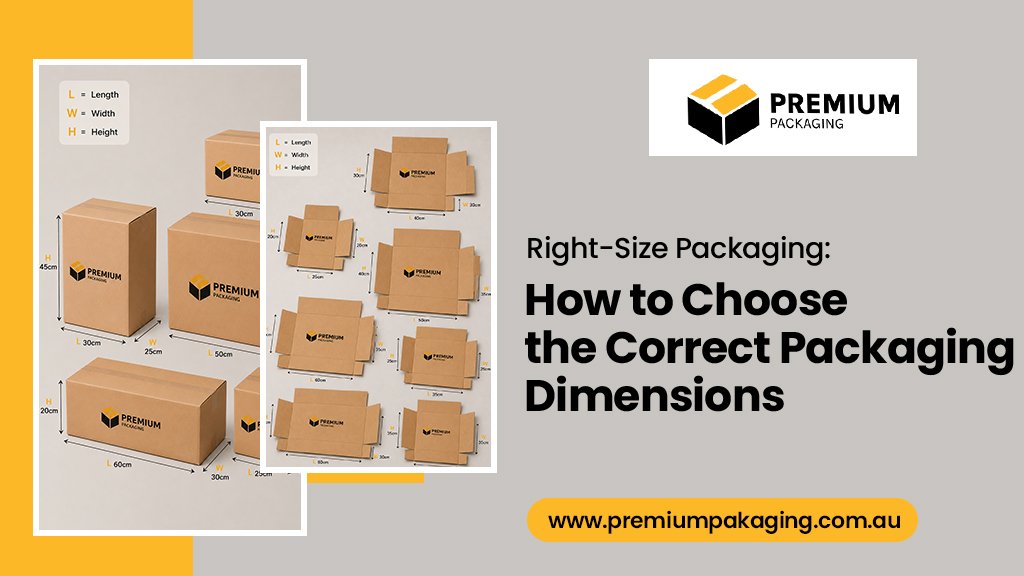
External dimensions. The outside length, width and height of the carton. These are what couriers measure and what determines whether the parcel fits dimensional weight rules, satchel rate brackets and pallet stacking patterns.
Internal dimensions. The usable space inside the carton once the board thickness is accounted for. Internal dimensions are what actually need to match the product. Single-wall corrugated typically removes 3 to 5 millimetres per side. Double-wall takes more. Mailing boxes with self-locking lids also lose a few millimetres at the top edge to the locking flaps.
A practical workflow looks like this:
- Measure the longest dimension of the product, then the next-longest, then the shortest.
- Add room for any cushioning or void fill the product needs (typically 20 to 40 millimetres on each side for fragile items).
- Match the result to a stock carton’s internal dimensions, not its external dimensions.
- Check the external footprint against your courier’s rate bands and your pallet pattern.
Operations that document this process and put it on a laminated card next to the pack bench almost always cut their wrong-fit issues within a quarter.
The Hidden Costs of Getting It Wrong
Wrong-sized packaging shows up in invoices that most procurement teams never directly link back to the carton range.
Dimensional weight surcharges. Australian couriers charge based on whichever is greater: actual weight or dimensional (volumetric) weight. Oversized cartons inflate dimensional weight even when the contents are light. A single carton size that’s two centimetres oversized in one direction can shift thousands of parcels into the next billing band over the course of a financial year.
Void fill costs. Every centimetre of empty space inside a carton needs to be filled with paper, bubble wrap, or another protective material; otherwise, the product can move and damage itself. That’s a direct material cost, plus the staff time to apply it.
Damage rates and returns. Undersized cartons crush their contents. Oversized cartons let products shift in transit. Both produce damage claims, return postage, replacement stock and the customer service hours that come with all of it.
Storage footprint. Carton sizes that don’t match the product range eat up valuable warehouse space, both in stock holding and at the pack station.
A short audit of the past quarter’s outbound parcels, sorted by weight band and longest dimension, almost always reveals where the format mix has drifted out of step with what’s actually being shipped.
Mailer Size Selection for eCommerce
For eCommerce operations dispatching apparel, accessories, beauty, books or other lightweight goods, mailing boxes do the bulk of the work. Effective mailer size selection starts by grouping orders by their natural shape rather than trying to find a one-size-fits-all solution.
A practical mailer range typically covers:
- A small flat profile for thin, light items (envelope-style sends, accessories)
- A medium mailer for folded apparel or stacked small goods
- A larger mailer for bundled multi-item orders
- A deeper mailer for items with more height than length
Premium Packaging stocks mailing boxes in sizes built around these common shapes, which removes most of the guesswork from the initial size-range decision.
Shipping Box Sizing for Heavier Goods
Once weight, fragility or stacking pressure is in the picture, shipping box sizing gets more technical. Single-wall corrugated handles most light-to-medium goods. Double-wall steps in for heavier or fragile items, longer freight distances or pallet stacking. Heavy-duty grades cover industrial dispatch, hardware and bulky homewares.
A few sizing rules worth carrying through every procurement decision:
- Match the box’s internal dimensions to the product plus cushioning, not the product alone.
- Aim for the product to fill at least 70 per cent of the internal volume where possible.
- Specify the right board grade for the journey, not just the weight.
- Keep the size range tight enough for pickers to memorise.
The Sustainability Lever Hiding in Plain Sight
Right-sizing is one of the most direct contributors to sustainable packaging solutions any business can implement. The mechanics are simple. Smaller cartons use less board. Less void fill is needed. More parcels fit on a pallet, which lowers the per-order freight emissions. Less material reaches the customer’s recycling bin at the other end.
This is often a stronger sustainability story than swapping materials alone. A right-sized recycled-content carton with paper void fill outperforms an oversized eco-branded mailer on almost every measure that matters: total material weight, transport efficiency, and end-of-life recoverability.
When Custom Packaging Earns Its Place
Stock sizes work hard for most operations, but there’s a point where order dimensions are consistent enough that bespoke pays off. Custom packaging solutions typically make sense when:
- A core product or kit has fixed dimensions repeated across thousands of orders
- The closest stock size leaves more than 25 per cent void volume
- Brand presentation directly influences repeat purchase behaviour
- A custom carton can fold, stack or assemble faster on the line than a stock equivalent
Custom doesn’t always mean a complete redesign. Tightening a stock-size range to match your top three or four product shapes often delivers most of the benefit without the lead times and minimum order quantities of fully bespoke runs.
Building a Size Range That Holds Up
The endgame isn’t to stock every possible carton size. It’s to hold a small, well-chosen range that covers the bulk of your dispatch profile, with a couple of fallback options for outliers.
A typical right-sized range for a growing eCommerce business looks like:
- Two to three mailer sizes for lightweight orders
- Three to four shipping box sizes covering most fragile and heavier orders
- One or two larger or specialist cartons for outliers
Pickers can memorise this range. Procurement can negotiate better terms on fewer SKUs. Storage stays compact. And the freight invoice starts behaving more predictably.
Frequently Asked Questions
How do I work out the right packaging size for my products?
Measure the product’s longest, second-longest and shortest dimensions, add allowance for any cushioning, and match the result to the internal dimensions of a stock carton. Don’t measure against external dimensions, which include the board thickness.
What’s the difference between dimensional weight and actual weight?
Actual weight is the parcel’s weight on the scale. Dimensional weight is calculated from the parcel’s volume. Australian couriers charge on whichever is higher, which is why oversized cartons inflate freight cost even on light orders.
Can I use one carton size for everything to keep procurement simple?
You can, but it almost always costs more. One size means oversized parcels, more void fill and higher dimensional weight surcharges across most of your dispatch volume. A tight range of three to seven sizes usually delivers a much better total cost.
Are smaller cartons always more sustainable?
Generally, yes, because they use less material and reduce freight emissions. The bigger sustainability win comes from combining right-sizing with recycled-content board and paper-based void fill, so the entire parcel can be recycled in a single stream.
Does Premium Packaging help businesses choose the right packaging size?
Yes. The team can review your dispatch profile and recommend a stock size range or a custom configuration tailored to your actual order shapes and freight networks.
Closing the Bench
Right-sizing isn’t about chasing the smallest possible carton. It’s about matching every dimension to the way your business actually ships, so material, freight and damage costs all move in the right direction at once. For procurement and operations teams reviewing their packaging mix this year, it’s one of the highest-leverage projects available and one of the easiest to measure. Premium Packaging’s range covers stock and tailored configurations across mailers, shipping cartons, and protective lines, so the right-sized parcel leaving your warehouse doesn’t have to compromise on protection or presentation.