Safety warnings on packaging are more than just symbols – they are an essential way to protect consumers, workers and the environment. Whether you are shipping glassware across town or exporting chemicals overseas, the correct warning label ensures that everyone along the supply chain understands how to handle the package. In Australia, incorrect labelling can lead to damaged goods, fines or even harm to people or wildlife. Premium Packaging prepared this guide to explain the leading packaging warning labels, what they mean and when they must be used according to current regulations.
In packaging, warning labels fall into six main groups: risk-level signs (Danger, Warning, Caution), handling and care symbols (Fragile, This Side Up, Keep Dry), GHS chemical pictograms, Australian Dangerous Goods (ADG) class labels, suffocation warnings on poly bags, and product-specific warnings for items like alcohol, tobacco and children’s products. Each one tells handlers how to move, store and open a package safely and legally.
What a Warning Label Means
A warning label is a printed symbol, signal word or statement applied to packaging to tell handlers about a hazard and how to manage it safely. It communicates the level of risk, the type of danger and the precautions required, often without relying on written language so anyone across the supply chain can understand it at a glance.
For Australian businesses, warning labels carry legal weight. They sit under the Work Health and Safety (WHS) Regulations, the Globally Harmonised System (GHS 7) for chemical hazards and the Australian Dangerous Goods (ADG) Code for transport. A correct label protects the people who move your goods, keeps the consignment compliant at every checkpoint and reduces the risk of damaged stock, rejected deliveries or penalties.
Why warning labels matter
- Legal compliance: In Australia, hazardous chemical labels must follow the Globally Harmonised System (GHS) of classification and labelling (currently GHS 7). Importers must ensure that chemical labels comply with the GHS and the model Work Health and Safety (WHS) Regulations, and they may substitute GHS pictograms with Australian Dangerous Goods (ADG) class labels when the hazards are equivalent.
- Safety and risk management: Danger, warning and caution labels communicate different levels of risk – from immediate life‑threatening hazards to minor injuries. Handlers know whether they can stack a box, keep it dry or keep it upright, reducing the chance of accidents during storage and transit.
- Consumer protection: Suffocation warnings on poly bags protect infants from accidental asphyxiation. Child‑safety labels warn when small parts pose choking hazards.
- Environmental and sustainability messaging: Recycling symbols show that materials can be recycled or contain recycled content, while Forest Stewardship Council (FSC) marks indicate paper sourced from responsibly managed forests.
1. Risk‑Level Signs: Danger, Warning and Caution
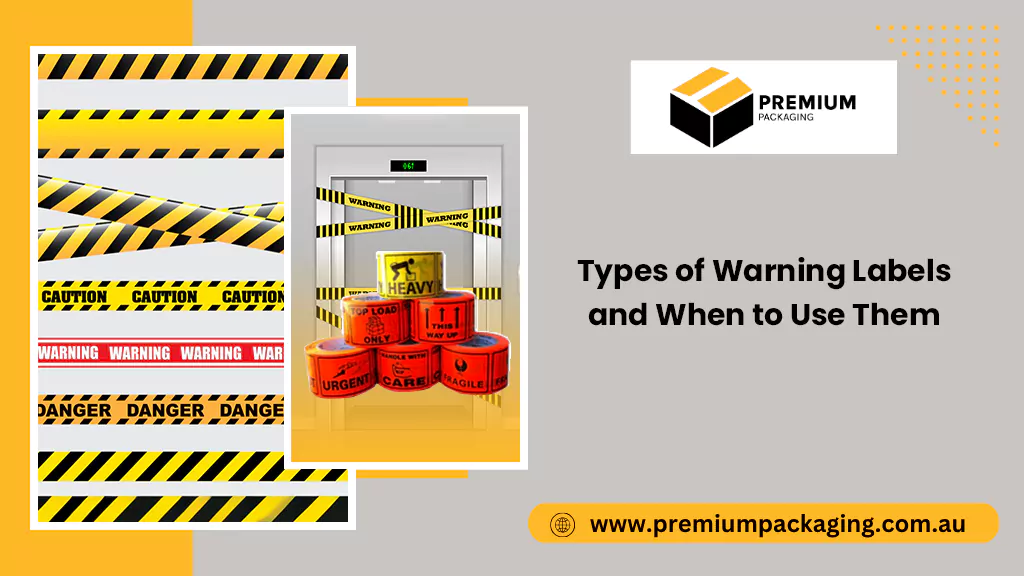
The level of risk determines whether a package requires a Danger, Warning or Caution label. These signs use bold colours and signal words. In Australia they align with AS 1319, the standard for safety signs in the occupational environment, so the same red, orange and yellow hierarchy appears across warehouses, loading docks and transport nationwide. The international ANSI Z535 system follows the same logic, which is useful when you export.
| Level | Colour/Signal Word | Meaning and when to use | Example packaging uses |
| Danger | Red header with white text | Indicates an immediate risk of serious injury or death. | High‑voltage panels, confined spaces, machinery entrapment zones, explosives. |
| Warning | Orange header | Warns of a significant risk of harm or death that is less immediate than “Danger”. | Rotating equipment, hot surfaces, chemical exposure, heavy machinery. |
| Caution | Yellow header | Advises of potential moderate risk such as slips, trips or minor injuries. | Wet floors, low clearance, pinch points on equipment, minor machinery hazards. |
Other specialised warnings include biohazard, electrical hazard, flammable material, compressed gas, laser hazard, high‑temperature and choking‑hazard labels, each tied to specific standards. For example, a biohazard sign must appear on packages containing medical waste or laboratory specimens For example, a biohazard sign must appear on packages containing medical waste or laboratory specimens. In Australia these move as Class 6.2 infectious substances under the ADG Code and must be labelled and documented accordingly.
2. Handling and Care Symbols
International packing symbols are widely recognised and help carriers and recipients protect goods during transportation. These packaging warning labels provide clear instructions without language barriers. Many are voluntary, but using them correctly enhances safety and customer satisfaction.
Orientation and fragility
- This Side Up: Two arrows pointing upwards show the correct orientation; the package must not be carried sideways or upside‑down.
- Fragile: The word Fragileor a broken glass symbol warns that the contents are delicate and should be handled gently. Glassware, ceramics and electronics often require this label.
- Handle with Care: Hands cupping a box indicate that the package contains intricate parts and should not be stacked.
Environmental conditions
- Keep Dry: An umbrella symbol indicates that the box must be kept away from rain or moisture, as the contents are not waterproof.
- Temperature‑Sensitive: A thermometer symbol shows the temperature range in which the product must be stored.
- Protect from Direct Sunlight: A sun with a slash through it warns that contents are sensitive to light or heat.
- Flammable Materials: A flame symbol alerts handlers that the contents can ignite when exposed to sparks or heat.
Handling instructions
- Do Not Open with Knife: Prevents damaging the contents when opening the box.
- Do Not Place Near Magnets: Used when products may be affected by magnetic fields (e.g., sensitive electronics).
- Maximum Stacking Height: Horizontal bars with a number specify how many similar boxes may be stacked safely.
- Do Not Stack/Do Not Hook/Do Not Lift: Symbols with crossed‑out icons tell handlers not to stack, hook or single‑handedly lift the box due to fragility or weight.
- Centre of Gravity (Scope):Indicates weight distribution to help forklifts lift the load safely.
- Two‑Person Lifting/Trolley Lifting: Suggests that multiple people or a trolley should be used when moving heavy items.
Sustainability symbols
Australian consumers increasingly expect eco‑friendly packaging. Labels like the recycle sign (the familiar triangle) tell customers that the package is recyclable or made from recycled materials. The FSC mark certifies that paper products come from responsibly managed forests. Australian businesses increasingly expect clear on-pack recycling guidance. The Australasian Recycling Label (ARL) is the recognised standard here, telling handlers and customers which components belong in kerbside recycling. The recycle triangle and plastic identification codes (1 to 6) indicate the polymer type, and the FSC mark certifies paper and board from responsibly managed forests. These verifiable marks matter as Australian businesses tighten their packaging sustainability reporting.
Warning Label Examples and What They Signal
Warning labels fall into a few practical groups. Here are common examples Australian businesses apply to packaging, with what each one tells the handler:
- Risk-level signs: Danger (red), Warning (orange) and Caution (yellow) headers rank a hazard from an immediate threat to life down to a minor injury risk such as a pinch point.
- Handling and orientation symbols: This Side Up, Fragile, Handle With Care and Keep Dry guide how a carton is carried, stacked and protected in transit.
- GHS pictograms: The red diamond symbols such as Flame, Corrosion and Skull and Crossbones identify chemical hazards on products classified under GHS 7.
- Dangerous goods class labels: The nine ADG classes, from Explosives through to Miscellaneous Dangerous Goods such as lithium batteries, must stay visible on the outside of a package during road or rail transport.
- Suffocation warnings: Applied to poly bags to alert that the bag is not a toy and must be kept away from young children.
- Sustainability marks: Recycling symbols and the FSC mark show whether packaging is recyclable or sourced from responsibly managed forests.
The right combination depends on the product, the hazard and the route it travels. Premium Packaging supplies pre-printed warning labels on roll so businesses can apply consistent, compliant marking across every consignment.
3. GHS Hazard Pictograms
For chemicals, Australia follows GHS 7 for classification and labelling. The nine GHS pictograms appear in a red diamond and must be accompanied by signal words, hazard statements and precautionary statements. Only eight are mandatory in Australia (the environmental pictogram is optional).
| Pictogram | Meaning & application | When to use |
| Health Hazard (silhouette) | Indicates chronic health effects such as carcinogenicity, respiratory sensitisation or reproductive toxicity. | Use on packages containing substances that can cause long‑term health damage. |
| Flame | Flammable materials or substances liable to ignite spontaneously or emit flammable gas. | Flammable liquids, self‑heating substances and chemicals emitting flammable gas. |
| Exclamation Mark | Immediate skin, eye or respiratory irritants or narcotic effects. | Irritants, skin sensitisers, acute toxicity (low hazard), narcotics. |
| Gas Cylinder | Gases under pressure. | Cylinders of compressed, liquified or dissolved gases such as ammonia or acetylene. |
| Corrosion | Substances causing skin corrosion/burns or eye damage, or that corrode metals. | Strong acids and bases; requires corrosion‑resistant packaging. |
| Exploding Bomb | Explosive or self‑reactive materials. | Used for pyrotechnics, fireworks and self‑reactive chemicals. |
| Flame Over Circle | Oxidising substances that intensify fires. | Oxygen releasers such as ammonium nitrate or hydrogen peroxide. |
| Skull and Crossbones | Acute toxicity causing severe poisoning. | Poisons and highly concentrated acids or pesticides. |
| Environment (optional) | Chemicals toxic to aquatic life. | Used on products that harm water ecosystems (not mandatory under WHS regulations). |
4. Dangerous Goods Classes and Transport Labels
The Australian Dangerous Goods (ADG) Code classifies hazardous materials into nine classes, each with its own hazard label. These labels must be clearly visible on the outside of packages and remain affixed during transit. Examples include:
- Class 1 – Explosives: Items like ammunition, fireworks and detonators require explosive hazard labels.
- Class 2 – Gases: Compressed, liquified or dissolved gases (butane, oxygen, chlorine) use flame or gas‑cylinder labels. Class 2 is subdivided into flammable, non‑flammable/non‑toxic and toxic gases.
- Class 3 – Flammable Liquids: Petrol, alcohol, perfumes and paints have flammable liquid labels.
- Class 4 – Flammable Solids: Substances that can combust spontaneously or emit flammable gases, such as matches or sodium.
- Class 5 – Oxidising Substances and Organic Peroxides: Oxidisers like ammonium nitrate or organic peroxides that can intensify fires.
- Class 6 – Toxic and Infectious Substances: Toxic chemicals (chloroform, cyanides) or infectious materials (medical waste) require skull‑and‑crossbones or biohazard labels.
- Class 7 – Radioactive Materials: Uranium, radioactive isotopes and x‑ray equipment must display radiation warning labels.
- Class 8 – Corrosives: Acids and corrosive cleaners that can destroy skin or materials.
- Class 9 – Miscellaneous Dangerous Goods: Hazardous substances not covered by other classes (e.g., lithium batteries) require a black‑and‑white stripes label.
When packing dangerous goods for road or rail, you can replace GHS pictograms with ADG labels if they represent the same hazard. However, do not display both icons for the same hazard on one label.
5. Suffocation Warnings on Poly Bags
Transparent poly bags used to protect clothing or small parts are convenient but can pose a suffocation risk to children. Transparent poly bags used to protect garments or small components are convenient but can pose a suffocation risk to young children. Australia does not mandate specific suffocation-warning wording on plastic packaging, but a printed warning that the bag is not a toy and must be kept away from babies and children is widely adopted best practice, particularly for retail and eCommerce consignments. Larger, thinner bags carry the greater risk, so the warning matters most on those lines.
6. Product‑Specific Warning Labels
Some products have mandatory warnings dictated by consumer‑protection laws. As a packaging supplier, Premium Packaging should be aware of these requirements and advise clients accordingly.
- Hazardous materials: Packages containing hazardous chemicals, acids or abrasives must follow specific laws and include hazard pictograms and handling instructions.
- Alcohol and tobacco: Alcohol labels must display statutory warnings about age limits, health risks and responsible consumption. Tobacco products must carry health warnings and graphic images under Australian law.
- Export destinations: Goods sold overseas may need destination-specific warnings, such as a California Proposition 65 warning for the United States market. Confirm each destination’s rules before shipping so labels stay compliant on arrival.
- Prescription medicines and medical devices: These require clear instructions, dosage information and regulatory warnings, often printed on extended‑content labels to provide sufficient space.
- Child‑safety warnings:Toys and children’s products must carry warnings about age suitability and small parts under the mandatory safety standards administered by the ACCC. Since 2022, Australia has also required warnings and secure compartments for button and coin batteries under a mandatory safety standard.
7. Choosing the Right Warning Labels
Selecting the appropriate label involves understanding the product, the distribution channel and the legal framework:
- Identify hazards: Conduct a risk assessment to determine whether the product poses physical, chemical, biological or environmental risks. This will dictate whether you need hazard pictograms, transport class labels or simple handling symbols.
- Consider transit conditions: Fragile items need orientation and fragility labels; liquids may require “This Side Up” and “Keep Dry” icons. Heavy boxes may need two‑person or trolley lifting symbols.
- Comply with regulations: If you are shipping chemicals in Australia, use GHS 7 pictograms and ensure the label includes the required signal word, hazard statement, precautionary statement and supplier details. For dangerous goods, refer to the ADG Code and include the correct class label.
- Check destination requirements: For domestic Australian consignments, focus on GHS 7, the ADG Code and the ACCC consumer product standards. If you export, check each market separately, since some add requirements such as a California Proposition 65 warning in the United States. If exporting to multiple countries, ensure your labels meet each region’s standards.
- Select durable materials: Choose adhesives and substrates that withstand the package’s environment—waterproof labels for chilled goods, UV‑resistant inks for items exposed to sunlight, and tamper‑evident labels for pharmaceuticals.
- Brand integration: Work with a label printer to design custom warning labels for packaging that integrate your brand colours and logos while maintaining the required symbols and legibility. For example, you can place the GHS pictogram alongside your brand’s icon, but the hazard symbol must remain clear and unaltered.
8. Custom Warning Labels & Packaging Supplies Safety Labels
At Premium Packaging, we specialise in custom warning labels for packaging that balance regulatory compliance and brand aesthetics. Our service includes:
- Material selection: We help clients choose between paper, plastic or synthetic labels depending on durability and budget. For refrigerated goods, we recommend moisture‑resistant labels that won’t smudge or peel.
- Printing technology: We use high‑resolution printing and adhesives suitable for various surfaces, ensuring that the labels remain legible and intact throughout the supply chain.
- Design support: Our designers integrate warning symbols with your brand identity without compromising readability or compliance. We also ensure alt text is provided for images on digital copies to satisfy accessibility guidelines.
- Safety label kits: For businesses shipping dangerous goods, we supply complete kits containing ADG class labels, handling symbols, pallet placards and documentation sleeves, ensuring packages meet transport regulations.
Conclusion
Proper packaging warning labels are a cornerstone of safe, compliant and customer‑friendly logistics. From orientation symbols and environmental warnings to GHS pictograms and suffocation labels, each label serves a specific purpose. As regulations evolve – particularly around chemical hazard communication and environmental sustainability – staying informed is crucial. Premium Packaging can guide you through the maze of standards and provide custom warning labels for packaging that protect your goods, your customers and the planet.
Frequently Asked Questions (FAQ)
What is the difference between “Danger”, “Warning” and “Caution” labels?
Danger indicates an immediate risk of severe injury or death and typically uses a red header. Warning denotes a serious hazard that is less immediate but can still cause significant harm; the header is orange. Caution advises of moderate risks such as minor injuries and uses a yellow header.
Do I need to include suffocation warnings on poly bags in Australia?
Australia does not mandate specific suffocation-warning wording on plastic packaging. Many businesses still print a warning that the bag is not a toy and must be kept away from babies and children, as best practice for retail and eCommerce lines. The larger and thinner the bag, the more important the warning becomes.
Are GHS pictograms required on consumer product packaging?
GHS pictograms are mandatory on the labels of hazardous chemicals in Australia. Consumer products that are not classified as dangerous under the GHS (e.g., ordinary cosmetics) may not require these symbols. However, if your product contains ingredients that pose chronic or acute hazards, you must include the relevant pictograms along with signal words and hazard statements.
How do I choose the correct handling and orientation labels for my shipment?
Assess the fragility, weight and environmental sensitivity of your product. Use “Fragile”, “This Side Up” or “Handle with Care” symbols for delicate items; “Keep Dry” or “Temperature‑Sensitive” labels for moisture‑ or heat‑sensitive goods; and “Two‑Person Lift” or “Trolley Lift” symbols for heavy packages. Ensure labels are visible and placed near the address panel.
Can I customise warning labels and still meet regulations?
Yes. You can incorporate brand colours or design elements, but the hazard pictograms, signal words and mandatory text must remain clear, legible and unaltered. In Australia, labels for hazardous chemicals must follow GHS 7 standards. For dangerous goods, use the appropriate ADG class labels and ensure they are the correct size. Working with a professional label supplier, such as Premium Packaging, ensures that your custom designs meet regulatory and safety requirements.