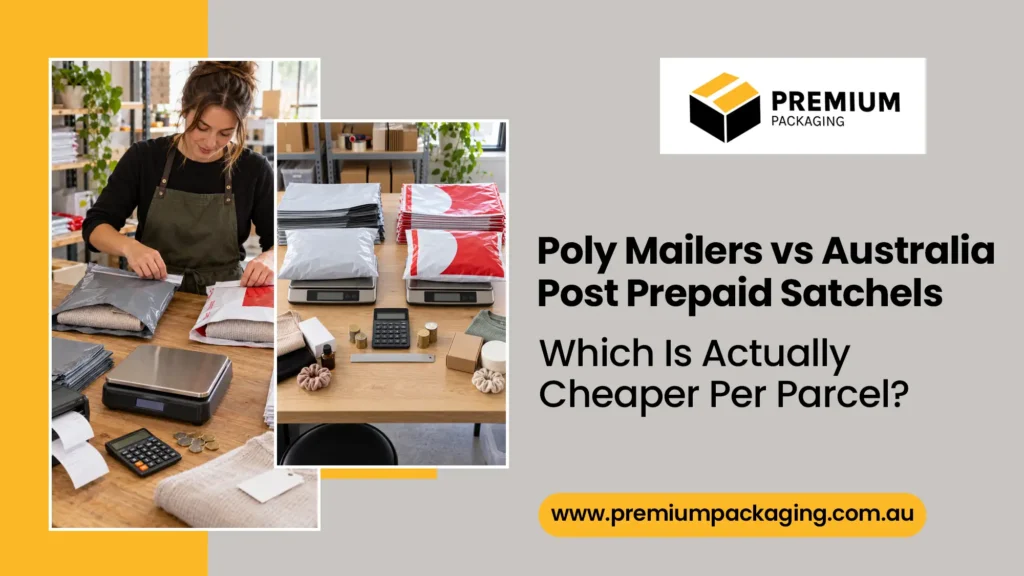
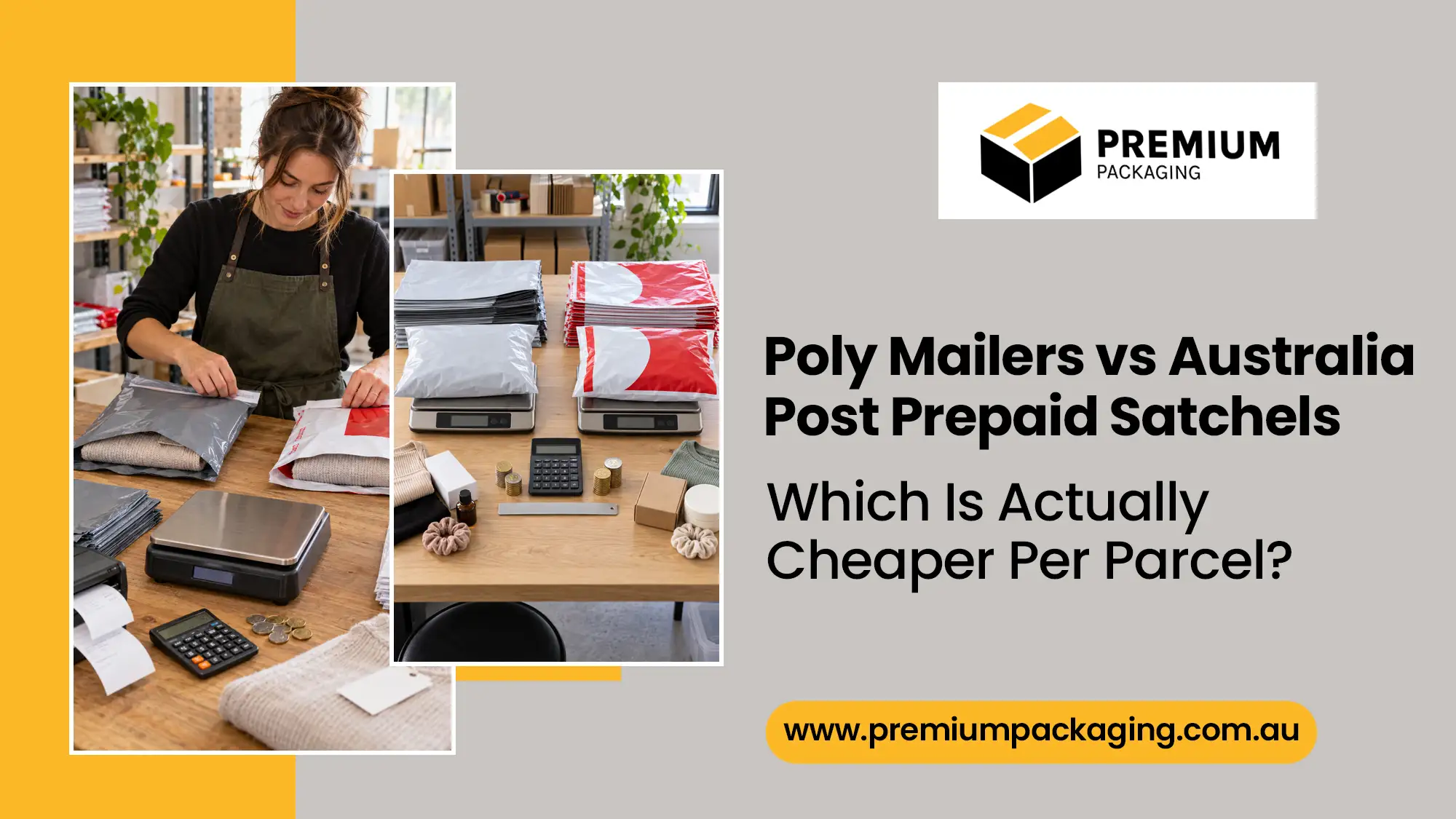
Poly mailers vs Australia Post prepaid satchels: Which is actually cheaper per parcel?
It is one of the most common questions in an online retail dispatch area. Prepaid satchels are simple, with postage already included, so one price covers the lot. Your own mailers look lighter on paper but need postage paid separately. Which one actually works out lower per parcel depends on your products and your sending volume, and the answer genuinely changes from business to business.
Rather than quote figures that move with every postage review, this guide sets out how the two charging models work and gives you a method for calculating your own true number. That way the answer stays right for your operation after the next rate change.
The two charging models are fundamentally different
Before you can compare anything, it helps to see that the two options are priced on completely different logic.
Prepaid satchels: flat rate by size
A prepaid satchel bundles the bag and the postage into a single purchase. Within the stated weight limit, postage is charged on the size of the satchel rather than what the parcel weighs. Anything you fit inside, up to that limit, travels for the same price. Simple, predictable, and it needs no postage account.
Your own mailers: packaging plus postage, charged on weight or size
Buying your own mailers separates the two costs. You pay for the mailer, then pay postage through your own carrier arrangement. That postage is generally charged on whichever is greater, the actual weight of the parcel or its cubic weight, which is worked out from its dimensions. For most Australian parcel services, the cubic conversion factor is 250 kilograms per cubic metre, so length by width by height in metres, multiplied by 250, gives the cubic weight the carrier may charge on.
That difference drives everything. A flat rate rewards you for filling the space. Weight and cubic pricing rewards you for keeping the parcel small and light.
Work out your own cost per parcel
Run this calculation on your three or four most common order types rather than on an average parcel, because averages hide the cases where you are losing the most.
Step 1: Pack a real order and measure it Take a typical order, pack it the way your team actually packs it, then weigh it and measure the packed dimensions. Measure the parcel as it finishes, not the flat mailer, because a filled bag gains thickness.
Step 2: Work out the cubic weight Multiply length by width by height in metres, then by 250. Compare that figure to the actual weight. The higher of the two is what postage is generally charged on, which is why bulky light parcels cost more than people expect.
Step 3: Add every packaging item, not just the mailer Count the mailer, the label, any tape, and any protective packaging or void fill inside. A mailer that looks lighter on its own can lose that advantage once the padding it needs is counted in.
Step 4: Price the same parcel both ways Work out the total for your own mailer plus your carrier rate at your current volume tier, then the equivalent prepaid satchel size that would hold the same order. Use the rates your business actually pays, not published retail rates, because volume arrangements change the answer.
Step 5: Add the costs that sit outside the parcel Factor in packing time per order, damage and replacement rates, and stock you have to hold. A format that packs faster or arrives intact more often can be lower in total even when the unit looks higher.
When prepaid satchels tend to work out better
Low or irregular volumes: no account, no minimum order quantities and no stock to hold.
Dense, heavy-for-size items: flat rate by size means you are not charged for the weight you fit in.
Items that fill a satchel bracket neatly: little wasted space means little wasted spend.
Simplicity matters more than margin: one purchase, no rate tables and no label printing setup.
When your own mailers tend to work out better
Steady, growing volume: carrier arrangements generally improve as volume rises, while a flat rate does not.
Light items: when a parcel weighs very little, paying postage on its actual weight beats a flat rate built for up to several kilos.
Odd sizes between satchel brackets: a right-sized mailer avoids being pushed up into the next bracket.
Branding matters: your own packaging carries your identity to the customer rather than a carrier’s.
You use more than one carrier: your own packaging is not tied to a single network.
The two models side by side
Factor
Prepaid satchel
Your own mailer
What you buy
Bag and postage together
Mailer, then postage separately
Postage charged on
Size bracket, within a weight limit
Actual or cubic weight, whichever is greater
Effect of volume
Flat, limited movement
Generally improves as volume grows
Right-sizing
Fixed brackets to fit into
Size the pack to the product
Branding
Carrier branded
Your own presentation
Carrier choice
Tied to that network
Use whichever carrier suits
Setup needed
None
Account, labels and stock on hand
Best suited to
Lower or irregular sending
Regular, growing dispatch volumes
The trap most businesses miss: Paying to post air
The most common and most expensive mistake is using a mailer much larger than the order needs. An oversized bag adds bulk, the parcel cubes out, and postage is charged on that inflated figure rather than the light contents. The same mistake repeats on every order of that type, which is what makes it costly.
The fix is to hold a small range of sizes that genuinely match your product mix, then pack each order in the smallest format that still protects it. Where the item needs cushioning, a bubble mailer builds the protection into the envelope rather than adding a separate layer of wrap and a larger outer, which keeps the finished parcel smaller. Paper padded mailers do the same job with a paper outer. For items that genuinely need a carton, right-sizing matters just as much, and our guide to box types and when to use them covers how to match the format to the product.
Match the format to what you send
Cost per parcel is only the right answer if the goods arrive intact, because a damaged order wipes out any saving the moment it is replaced. Soft goods and unbreakable items suit a flat mailer. Fragile or awkward items need cushioning, either built into the mailer or added with bubble bags sized to the product. Rolled items such as prints, plans and posters travel better in a mailing tube. If you are unsure how much protection a product needs, our guide to choosing bubble wrap for shipping works through the options. Whichever format you choose, seal it with a carton sealing tape that holds first time, since a reseal or a failed seal in transit costs far more than the tape.
Where sustainability fits
Right-sizing is the one decision that improves both numbers at once. A smaller, better-matched pack uses less material, takes up less space in the delivery network, and generally costs less to send. Reviewing your most common order types for oversized packing usually turns up easy reductions in material use that need no change to how you work. Choosing recyclable formats and avoiding unnecessary layers of inner packaging builds on that.
Talk it through with Premium Packaging
Premium Packaging supplies wholesale dispatch packaging to Australian online retailers and distributors, including bubble and paper padded mailers, mailing tubes, cartons, protective packaging and sealing consumables across our mailing and dispatch range. Our team can look at what you send and recommend the formats and size range that fit your products, so your packing line is not defaulting to whatever bag is nearest.
We hold stock at Werrington in Western Sydney and ship nationwide, with recurring supply available for businesses that reorder on a cycle. Further guidance on choosing packaging formats is published on the Premium Packaging blog.
Frequently asked questions
Are prepaid satchels cheaper than using your own mailers?
It depends on your volume and what you send. Prepaid satchels often suit lower or irregular sending and dense items, while your own mailers tend to work out lower once volume is steady and parcels are light or oddly sized.
How is postage calculated if I use my own packaging?
Postage is generally charged on whichever is greater, the parcel’s actual weight or its cubic weight. Cubic weight is worked out from the packed dimensions, commonly using a factor of 250 kilograms per cubic metre.
What is cubic weight and why does it matter?
Cubic weight converts a parcel’s size into a chargeable weight, so bulky but light parcels are not carried for almost nothing. It matters because an oversized mailer can push a light order into a higher charge.
Does a prepaid satchel charge more if my item is heavier?
Not within the stated weight limit. Prepaid satchels are priced by satchel size rather than weight, which is why they suit dense, heavy-for-size items that would be charged more on a weight-based rate.
How do I reduce my cost per parcel without risking damage?
Right-size the pack to the product and build protection into the mailer rather than adding bulk around it. Stock a small range of sizes so each order goes in the smallest format that still protects the goods.