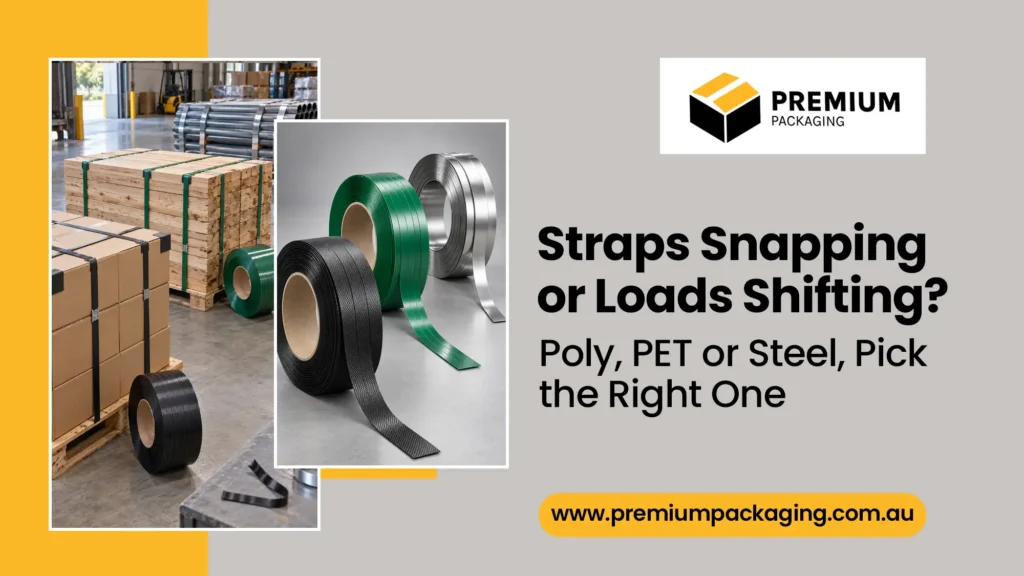
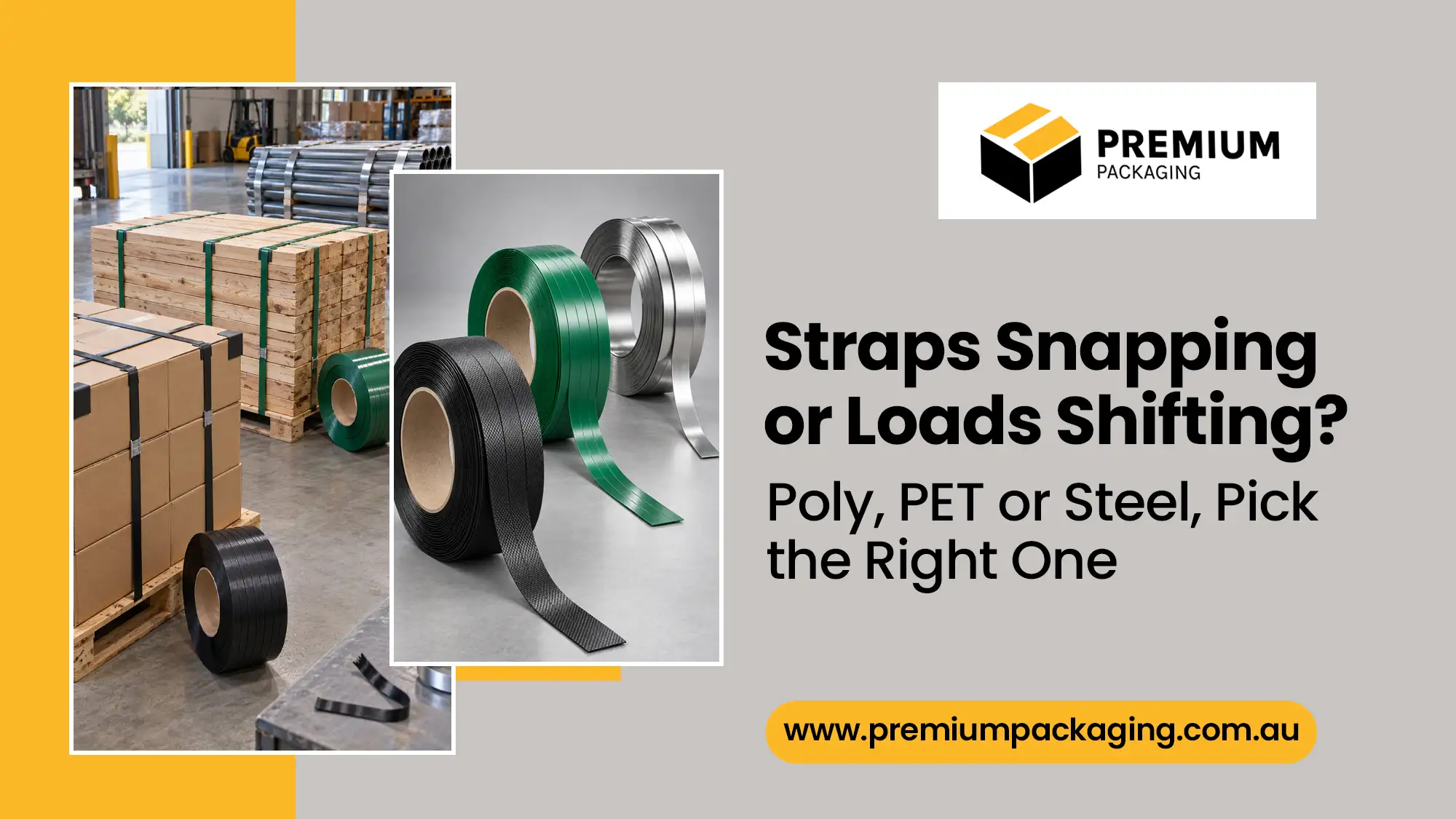
Straps snapping or loads shifting? Poly, PET or Steel: pick the right one
Two of the most common strapping problems point in opposite directions. Straps that snap suggest the strap is not strong enough or is being pushed too hard. Loads that shift suggest the strap is not holding its tension. Both usually come back to the same root cause: the wrong material for the load. This guide shows what each failure is telling you and which of poly, PET or steel fixes it, so your loads arrive the way they left.
It is written for warehouse supervisors, dispatch managers and procurement teams who need strapping that holds the first time, every time.
Two failures, two different causes
Snapping and shifting are not the same problem. A strap snaps when the force on it beats its break strength, when it is over-tensioned, or when a sharp edge cuts it. A load shifts when the strap cannot keep its tension as the load settles, compresses or is shaken in transit. The three materials behave very differently on both counts, which is why matching the material to the load is the real fix rather than simply pulling the strap tighter.
Why straps snap, and what fixes it
The strap is too weak for the load
The most common cause of snapping is a strap whose break strength is below what the load demands. Poly strapping is built for light to medium loads, so a heavy pallet will snap it. The fix is to step up the material rather than the tension: move from poly to PET strapping for heavy loads, and to steel strapping for the heaviest rigid loads.
The strap is over-tensioned
Pulling a strap tighter to stop a load moving often causes the opposite, because plastic straps break when tensioned past their limit and steel can snap under too much tension as well. The answer is to set the correct tension for the material and load with a proper tool, not to over-tighten a strap that is already at its limit.
Sharp edges are cutting the strap
A strap that fails at the corner of the load has usually been cut rather than overloaded. Sharp or hard edges concentrate the force on a thin line of strap and slice through it. Fit edge or corner protection under the strap at these points, which spreads the load and lets you keep the material you have.
A rigid strap meets a sudden shock
Steel has no give, so a sharp jolt in transit can fracture a steel strap that is holding a load which moves against it. PET behaves differently: it stretches under a shock and then returns to its original tension, which lets it ride out the vibration and impacts of long-distance freight that can break a rigid strap.
Why loads shift, and what fixes it
The strap relaxes and loses tension
Poly stretches easily, which is useful for bundling, but it does not recover that stretch. Over hours and days the strap relaxes, the tension bleeds away and the load loosens. On anything heavy or long-travelling, PET is the fix, because it recovers its tension after stretching and keeps the load tight.
The load settles under a rigid strap
Steel is strong but has no elasticity, so when a load settles or compresses after strapping, a steel band that was tight becomes slack and the load shifts inside it. For loads that settle, such as compressible or mixed goods, PET holds far better because it contracts with the load and keeps the tension on.
Not enough tension or too few straps
Sometimes the material is right but the application is not. Too little tension, or too few straps for the size of the load, lets goods move from the start. Increase the tension to the correct level, add straps where the load needs them, and confirm the material suits the weight.
Match the material to the failure
If your strapping is…
The likely cause
The fix
Snapping on heavy loads
Break strength too low for the load
Step up: poly to PET, or PET to steel or polywoven
Snapping at the corners
Sharp edges cutting the strap
Fit edge protection and keep the material
Snapping under a sudden jolt
Over-tensioned, or too rigid to absorb shock
Set correct tension; PET flexes where steel can fracture
Loosening after a while
Poly has stretched and lost its tension
Switch to PET, which recovers and holds tension
Loosening as the load settles
Steel has no give, so it goes slack
Use PET for its elastic recovery
Shifting from the start
Too little tension or too few straps
Increase tension, add straps, match the material
Poly, PET and Steel at a glance
Material
Break strength
Give and recovery
Use it when
Poly (PP)
Light to medium
Stretches, does not recover tension
Bundling and light to medium loads
PET (polyester)
High
Stretches under shock, recovers tension
Heavy loads that settle, shift or travel far
Steel
Highest
No give, rigid
Very heavy rigid loads that do not settle
Polywoven
High
Some give, surface safe
Heavy or awkward loads where steel would snap or scratch
A strong alternative: polywoven strapping
Where a load needs high strength but steel keeps snapping on shock or scratching surfaces, polywoven strapping is worth a look. Woven from polyester yarn, it carries a high break strength with the safety and corrosion resistance of a plastic strap, and it has enough give to absorb movement without failing. It is a common pick for furniture, machinery and other heavy or awkward loads.
Get the tension and tools right too
The strap is only half the system. A weak seal or joint fails just like a snapped strap, and the wrong tool cannot reach the tension the load needs. Match the tensioner, sealer and seals to the strap material and width, since poly, PET and steel each need their own. The full strapping range includes the tools and seals that go with each material, so the joint is as strong as the strap.
Load restraint and chain of responsibility
Under Australia’s Chain of Responsibility provisions in the Heavy Vehicle National Law, every party in the supply chain shares legal accountability for loads being safely restrained for road transport, and that includes the businesses that pack and strap them. A strap that snaps or a load that shifts is both a safety risk and a compliance one. Choosing a strap with adequate break strength and the right tension behaviour, then applying it correctly, is part of meeting that duty. For palletised loads, strapping works alongside pallet wrap and stretch film for full load security.
How Premium Packaging helps you fix strapping failures
Premium Packaging is a Sydney-based wholesale supplier stocking poly, PET, steel and polywoven strapping, along with the tensioners, sealers, seals and dispensers that go with each. Our specialists look at what is failing and why, then match the strap material, width and break strength to your loads and freight lanes, so the next run holds.
Stock is held at our Werrington warehouse with delivery across Sydney, Melbourne, Brisbane, Adelaide, Perth and regional Australia, and recurring supply keeps your packing lines running as volumes grow. For more on securing pallet loads, see our pallet packaging tips and the wider Premium Packaging blog.
Frequently asked questions
Why do my pallet straps keep snapping?
Usually the strap is too weak for the load, over-tensioned, or being cut by sharp edges. Step up to a stronger material such as PET, set the correct tension with the right tool, and fit edge protection on sharp corners.
Why do my loads keep shifting even though the straps hold?
The strap is likely losing tension. Poly stretches and does not recover, so on heavy or settling loads it slackens. PET recovers its tension after stretching, which keeps settling loads secure through transit.
Is PET strapping stronger than poly?
Yes. PET has a much higher break strength and, unlike poly, recovers its tension after the load settles or is jolted. It is the usual step up when poly straps snap or loosen on heavier loads.
When should I use steel instead of PET?
Steel suits very heavy, rigid loads that do not settle, such as metal or timber packs. If the load settles or compresses, steel goes slack because it has no give, so PET holds better on those loads.
Does strapping tension affect whether straps snap?
Yes. Too little tension lets loads shift, while too much can snap the strap or crush the load. Matching the tension and material to the load, and using the correct tool, prevents both failures.