
Walk through the packaging decisions of almost any Australian eCommerce business, retail operator, or food service supplier, and sooner or later the conversation will turn to corrugated board. The specific grade of corrugated you choose has a direct impact on product protection, presentation, storage efficiency, and freight performance. Yet for many businesses, the choice between flute types is made without a solid understanding of what each one actually delivers.
E-flute corrugated sits in a particularly useful position across the packaging spectrum. It is thin enough to store and ship efficiently, smooth enough to carry high-quality print, and structurally capable enough to protect a wide range of products across retail, eCommerce, and commercial applications. At Premium Packaging, we supply E-flute corrugated solutions to businesses across Australia, and this guide covers everything procurement managers, warehouse supervisors, and operations teams need to know before making a decision.
What Is Corrugated Fluting and Why Does It Matter?
Before focusing specifically on E-flute, it helps to understand what corrugated fluting actually is and what role it plays in packaging performance.
Corrugated board is made up of three layers. Two flat outer sheets, known as liners, sandwich a middle layer of wavy, arch-shaped paper. That middle layer is the fluting. The fluting is what gives corrugated board its strength, cushioning capability, and structural rigidity. Without it, you would simply have two flat sheets of paper pressed together.
The flute profile, which refers to the height and density of those arches, determines almost everything about how a corrugated sheet performs. A taller, larger arch provides more cushioning and compression strength. A shorter, denser arch creates a smoother surface, allows for tighter structural tolerances, and reduces overall board thickness.
Flute types are designated by letter, and those letters reflect the order in which each profile was developed, not their size ranking. The profiles in common commercial use include A, B, C, E, and F. Each has a defined role in packaging design, and no single profile is universally superior. The right choice depends on what you are packaging, how it is being transported, and what you need the packaging to communicate.
What Makes E-Flute Corrugated Different?
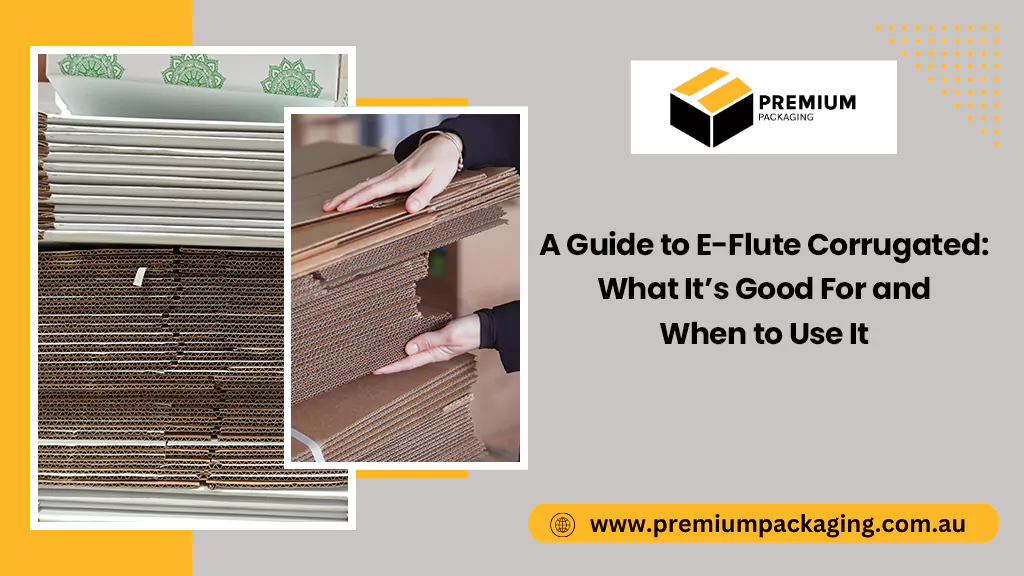
E-flute sits towards the thinner end of the corrugated spectrum. It measures approximately 1.5 to 2.0 millimetres in thickness and contains around 90 flutes per linear foot. That high flute density is the key to its performance.
Because the arches are smaller and more tightly spaced, the outer surface of E-flute board is noticeably smoother than thicker profiles like B or C flute. That smoothness is not incidental. It is what makes E-flute the preferred substrate when print quality is a priority.
For businesses where the packaging is part of the product experience, whether that is a branded mailer box for an eCommerce order or a retail shelf carton that needs to carry sharp graphics and clear colour, E-flute provides a surface that supports those outcomes in a way that bulkier corrugated profiles simply cannot match.
Beyond print performance, E-flute offers several other operational advantages that make it well-suited to specific commercial contexts.
Key Properties of E-Flute Corrugated
Smooth Print Surface
The density of flutes per foot in E-flute board creates a surface that is close to flat, giving it print characteristics that approach those of solid board. Litho printing, flexographic printing, and digital printing all perform at a higher standard on E-flute than on coarser profiles. Colour reproduction is more accurate, fine text is cleaner, and logo placement holds precision. For retail-facing packaging, this matters considerably.
Reduced Board Thickness
At roughly 1.5 to 2.0 millimetres, E-flute takes up significantly less space than B-flute (approximately 2.5 to 3.5mm) or C-flute (approximately 3.7 to 4.0mm). In practical terms, this means flatpacked E-flute cartons store more densely in your packaging room or warehouse, and the outer dimensions of finished boxes are smaller relative to the interior volume. For businesses managing freight costs on a per-cubic-metre basis, this reduction in board thickness translates to genuine savings over time.
Crush Resistance for Lightweight Products
E-flute is not a flimsy material. With around 90 flutes per foot, the dense arch structure provides solid crush resistance that is more than adequate for lighter to medium weight goods. It holds its shape under reasonable stacking pressure and protects contents from lateral impact effectively. The limitation comes at heavier load weights and larger box sizes, where thicker profiles begin to perform more reliably.
Weight Efficiency
E-flute board is lighter than the thicker corrugated profiles. For businesses calculating freight costs where weight is a billing factor, packaging made from E-flute contributes less to total shipment weight. Across large order volumes, the cumulative difference is worth accounting for in procurement decisions.
Eco-Friendly Material Options
E-flute corrugated is fully recyclable and is available in grades produced from recycled fibre content. For businesses working toward sustainability targets or carrying formal environmental commitments, E-flute sourced from responsibly managed material streams supports those goals without compromising packaging performance.
Where E-Flute Corrugated Performs Best
Understanding where E-flute excels means looking at the specific commercial applications where its properties align with operational requirements.
eCommerce Packaging and Mailer Boxes
For eCommerce businesses, E-flute is one of the most practical corrugated options available. The combination of smooth printability, compact thickness, and adequate crush resistance makes it well-suited for branded mailer boxes, subscription boxes, and product-specific shipping cartons.
The reduced board thickness means a mailer box built from E-flute takes up less space in your dispatch area when stored flat, and the finished box dimensions remain tight around the product, reducing void space and the need for excessive protective fill.
For businesses focused on unboxing experience, E-flute provides the surface quality needed to carry brand graphics without the cardboard texture bleeding through the print. That attention to presentation at point of opening reflects positively on the brand and supports repeat purchase.
Retail Shelf Packaging and Point of Sale Displays
Retail-facing packaging needs to look sharp at close range. Shoppers interact with shelf packaging directly, reading product information, examining graphics, and making judgements based on visual quality. E-flute delivers the print fidelity needed to support this application in a way that heavier corrugated board does not.
Retail cartons for cosmetics, personal care products, food accessories, household goods, and specialty items are all categories where E-flute is the preferred corrugated choice. The board is rigid enough to hold shape on shelf while remaining light enough that overall packaging weight does not add unnecessarily to freight or handling costs.
For point of sale display units, E-flute provides sufficient structural integrity for floor-standing or counter-top configurations while keeping the total weight of the assembled display manageable.
Lightweight Product Packaging for Courier and Freight
Products in the low to medium weight range, such as clothing, accessories, small homewares, stationery, personal care items, and packaged food accessories, are well served by E-flute corrugated cartons. The board protects adequately through standard courier handling and the reduced thickness keeps outer box dimensions as small as possible relative to the goods inside.
For businesses paying freight costs per cubic metre or per kilogram, the efficiencies that come with E-flute packaging are real and worth factoring into your packaging specification decisions.
Food Packaging Applications
E-flute corrugated is used across food packaging applications where a smooth, clean surface and structural integrity are required. Cartons for packaged food products, gift food hampers, specialty retail food items, and gourmet product ranges benefit from E-flute’s print capability and food-safe material options.
Where food contact compliance requirements apply, it is important to specify board grades produced with food-safe liners and adhesives. Premium Packaging can advise on the appropriate specifications for your application.
Die-Cut Boxes and Custom Structural Packaging
E-flute corrugated handles die-cutting and folding with greater precision than thicker profiles. This makes it suitable for custom structural packaging formats, including boxes with complex folds, internal inserts, tray and sleeve configurations, and self-locking bases. Businesses requiring packaging that follows the exact contours of a product, or that incorporates structural features to eliminate the need for loose fill, will find E-flute easier to work with from a conversion standpoint.
When E-Flute Is Not the Right Choice
Being clear about the limitations of E-flute is just as useful as understanding its strengths.
E-flute is not the appropriate specification for heavy or dense products. Once load weights move into the upper range or box sizes become large, the thinner profile begins to show limitations in stacking strength and compression resistance. For heavier goods, or for applications involving palletised stacking under significant load, B-flute or double-wall EB-flute are the more suitable specifications.
E-flute also has a lower tolerance for external moisture compared to thicker profiles. In warehouse or logistics environments where humidity exposure is a factor, board treatment or lamination may be required, or a more robust profile selected.
For very large outer shipping cartons carrying multiple units or heavy components, E-flute alone will generally not provide the structural performance required. In these cases, a double-wall combination such as EB-flute, which pairs the smooth outer surface of E-flute with the stacking strength of B-flute, is worth considering.
E-Flute vs Other Corrugated Profiles: A Practical Comparison
Understanding where E-flute sits relative to the other common profiles helps businesses make faster, more confident decisions at the specification stage.
E-Flute vs B-Flute
B-flute is thicker at approximately 2.5 to 3.5 millimetres and provides stronger cushioning and puncture resistance. It is commonly used for shipping boxes carrying heavier or fragile goods and for beverage trays and wrap-around packaging. B-flute has a reasonable print surface but noticeably less smooth than E-flute. Where heavy-duty protection is the priority over print quality, B-flute is the better specification. Where print quality, compact storage, and lighter product weights are the priority, E-flute is the stronger choice.
E-Flute vs C-Flute
C-flute is the most widely used corrugated profile globally, sitting at around 3.7 to 4.0 millimetres in thickness. It offers a good balance of cushioning, stacking strength, and print acceptability, and is commonly used for general shipping cases across a broad range of industries. For most standard brown-box shipping applications, C-flute performs reliably. Where branded presentation, compact dimensions, or lighter weight packaging is the requirement, E-flute is more appropriate.
E-Flute vs F-Flute
F-flute is thinner still than E-flute, at approximately 0.8 to 1.2 millimetres, and provides an even smoother print surface. It is used for luxury packaging, cosmetics, jewellery, and specialty retail applications where aesthetics take precedence. F-flute offers less structural depth than E-flute and is better suited to very lightweight and compact products. E-flute sits between F-flute and the heavier profiles, giving it a broader range of practical commercial applications.
Sustainability Considerations for E-Flute Corrugated
The environmental credentials of corrugated packaging are well established. Corrugated board has one of the highest recycling rates of any packaging material in Australia, and E-flute contributes to that profile positively.
Its reduced material volume per square metre compared to thicker profiles means less raw fibre is consumed per unit of packaging produced. More units can be transported in a single freight movement due to the compact nature of flatpacked E-flute blanks, which reduces the carbon footprint associated with inbound packaging logistics.
E-flute is available in grades incorporating recycled fibre content, supporting businesses with formal sustainability reporting obligations or those working toward waste reduction targets. When disposed of correctly, E-flute corrugated enters the recycling stream and can be processed back into new board, completing a circular material cycle.
Premium Packaging sources corrugated products with sustainability performance in mind, and our team can advise on the most appropriate eco-conscious specifications for your application.
Sourcing E-Flute Corrugated Through Premium Packaging
Premium Packaging supplies E-flute corrugated packaging solutions to Australian businesses across eCommerce, retail, food service, logistics, and commercial sectors. Our product range is stocked for commercial-scale procurement, and our team has the expertise to help businesses identify the right corrugated specification for their products, freight conditions, and brand requirements.
Whether your business needs standard E-flute cartons, mailer boxes, retail shelf packaging, or custom structural configurations, we can supply at the volumes your operation requires, with consistent quality across every order.
We deliver Australia-wide, including metro and regional areas, and work with businesses to establish supply arrangements that keep packaging inventory reliable and predictable.
Contact the Premium Packaging team to discuss E-flute corrugated solutions for your business, or explore our full range of corrugated and protective packaging products at premiumpackaging.com.au.
Frequently Asked Questions
Q1: What products are best suited to E-flute corrugated packaging?
E-flute corrugated is well suited to lightweight and medium weight products where print quality and compact packaging dimensions are important. Common applications include eCommerce mailer boxes, branded retail shelf cartons, subscription box packaging, food product cartons, cosmetics and personal care packaging, and die-cut custom boxes for specialty products. It is not the preferred specification for heavy goods, very large shipping cartons, or applications where significant stacking loads are involved, where a thicker profile such as B-flute or double-wall EB-flute would be more appropriate.
Q2: How does E-flute corrugated compare to standard shipping board for print quality?
E-flute provides a noticeably smoother printing surface than thicker corrugated profiles such as B or C flute. The high density of flutes per linear foot, approximately 90, creates a flat, even outer surface that supports sharper colour reproduction, finer text legibility, and more accurate logo placement. For businesses where the packaging needs to carry branded graphics at retail quality or support a premium unboxing experience, E-flute delivers a significantly better print outcome than standard shipping board.
Q3: Can E-flute corrugated be used for food packaging applications?
Yes, E-flute corrugated can be used in food packaging applications where a smooth, clean carton surface is required. For food contact applications, it is important to specify board produced with food-safe liners and adhesives that comply with relevant Australian food contact requirements. Premium Packaging can advise on the appropriate material specifications for your specific food packaging application to ensure compliance and performance are both met.
Q4: What is the difference between E-flute and EB-flute corrugated, and when should a business choose one over the other?
EB-flute is a double-wall configuration that combines E-flute as the outer layer with B-flute as the inner layer. The result is a board that carries the smooth, print-friendly surface of E-flute on the outside while benefiting from the stacking strength and cushioning depth of B-flute internally. EB-flute is the better specification for products that are heavier or more fragile and where both print quality and robust transit protection are required. For lighter products where the double-wall cost and thickness are not necessary, standard single-wall E-flute remains the more efficient and cost-effective choice.
Q5: Does Premium Packaging supply E-flute corrugated in bulk quantities for commercial operations?
Yes. Premium Packaging operates as a wholesale packaging supplier, which means we supply E-flute corrugated products at commercial volumes with consistent board grade and specification across orders. Businesses with ongoing procurement requirements, including eCommerce operators, manufacturers, and retail chains, can discuss volume supply arrangements with our team to ensure packaging inventory remains reliable and aligned with operational demand. Contact us directly to discuss your volume requirements and we will provide the appropriate guidance for your business.